Sourcing Humanoid Robot Actuators in 2026: Overcoming Pre-Modular Bottlenecks
A 2026 procurement guide for humanoid robot actuators: qualify modules, manage pre-modular supply risk, and compare custom vs. integrated sourcing paths.
For teams sourcing humanoid robot actuators in 2026, the primary bottleneck has shifted from proving motion control in a lab to securing robust, high-performance hardware at repeatable volume. The race is no longer exclusively about artificial intelligence and foundational software models; it is now a relentless sprint to qualify motors, reducers, encoders, drives, thermal paths, and suppliers that can scale together.
For procurement teams, sourcing managers, distributors, and hardware engineers, the landscape of humanoid robot actuators is fraught with complexities. The industry is currently trapped in what supply chain experts call the "pre-modular" phase. Standardized, off-the-shelf industrial actuators frequently fail to meet the extreme, nuanced requirements of humanoid form factors—namely, high torque density, ultra-low weight, exceptional thermal dissipation, and backdrivable precision.
This procurement guide breaks down the pain points of 2026, evaluates the engineering trade-offs required, provides a vendor qualification checklist, and outlines a strategic approach to scaling your humanoid production without falling victim to supply chain sprawl. Teams that are still building a first joint map can start with the Humanoid Robot Actuator Catalog, while lower-body projects should cross-check High-Torque Leg Actuator Modules before freezing the RFQ.
Last updated: July 21, 2026. Region: Global sourcing programs for humanoid robot OEMs, robotics labs, distributors, and hardware integrators.
This guide is a practical decision framework, not a live price list. The recommendations are based on public actuator design literature, official industry examples, rare-earth supply data, and common RFQ failure patterns seen when prototype teams move toward pilot builds. Final model selection still depends on your joint torque-speed table, mechanical envelope, duty cycle, voltage bus, firmware stack, destination country, and inspection plan. For a project-specific review, send the joint map through the catalog RFQ checklist.
Humanoid actuator sourcing is different from mature industrial motion-control buying. Many teams are still comparing the basic architecture of the robot: which axes need integrated rotary modules, which joints need quasi-direct-drive behavior, where a frameless motor stack is better, and whether a standard sample can be validated before a custom program starts.
This guide follows a catalog-first sourcing model. The goal is not to push every buyer into immediate custom co-development. The goal is to help engineering, procurement, and quality teams decide whether a standard actuator family, sample kit, or controlled OEM adaptation path is a credible first step.
Market signal
Procurement meaning
Recommended site path
Buyers search by category before the robot architecture is frozen
The first page they need is a structured catalog, not a single hero product
Read the rest of this article as a sourcing sequence: define the actuator family, check application risk, request the right evidence, then send a complete RFQ package.
In traditional industrial automation (e.g., robotic arms on an automotive assembly line), weight and space are rarely the primary constraints. Actuators can be bulky, heavy, and continuously cooled via external infrastructure. Humanoid robots, however, flip these constraints entirely.
A humanoid must carry its own power source and support its own weight, meaning every gram matters. Furthermore, to operate safely around humans, the joints must exhibit high backdrivability (the ability to yield to external forces) and rapid torque response.
Because traditional industrial components fall short, Original Equipment Manufacturers (OEMs) and robotics firms are forced to design custom subsystems. This results in the "pre-modular" dilemma:
Lack of Plug-and-Play Solutions: Procurement teams cannot simply order "Humanoid Knee Actuator Type B" from a catalog.
The Co-Development Trap: To secure the necessary performance, companies enter deep, early-stage co-development partnerships with niche motor and gearbox suppliers. While this yields functional prototypes, it locks the buyer into a single, proprietary ecosystem, limiting future procurement flexibility and bargaining power.
While assembling 10 impressive prototypes relies on intensive engineering labor, scaling to 1,000 or 10,000 units requires a paradigm shift. The inability of the current supplier ecosystem to support "large-scale" production volumes remains a significant constraint.
Procurement teams are no longer just buying parts; they are forced to act as active supply chain managers. The focus must shift from feasibility (can we make it work?) to manufacturability and quality assurance (can we make 10,000 of these with less than a 1% failure rate?).
At the module level, actuator procurement should be paired with controller and feedback planning. If the project is comparing drive electronics, bus protocols, or encoder packages alongside the joint itself, review Actuator Controller and Encoder Kits before separating the electrical and mechanical RFQs.
With the increasing need to diversify away from sole-source dependencies in high-risk regions, procurement must balance the push for "near-shoring" against cost. High tariffs on rare-earth magnets and precision-machined alloys have inflated the Bill of Materials (BOM). Selecting a vendor that offers transparent sourcing for critical raw materials is essential to mitigating sudden price shocks or embargoes.
Engineers want infinite torque in zero volume; procurement wants infinite volume at zero cost. To align these departments, it's crucial to understand the technical trade-offs that drive cost.
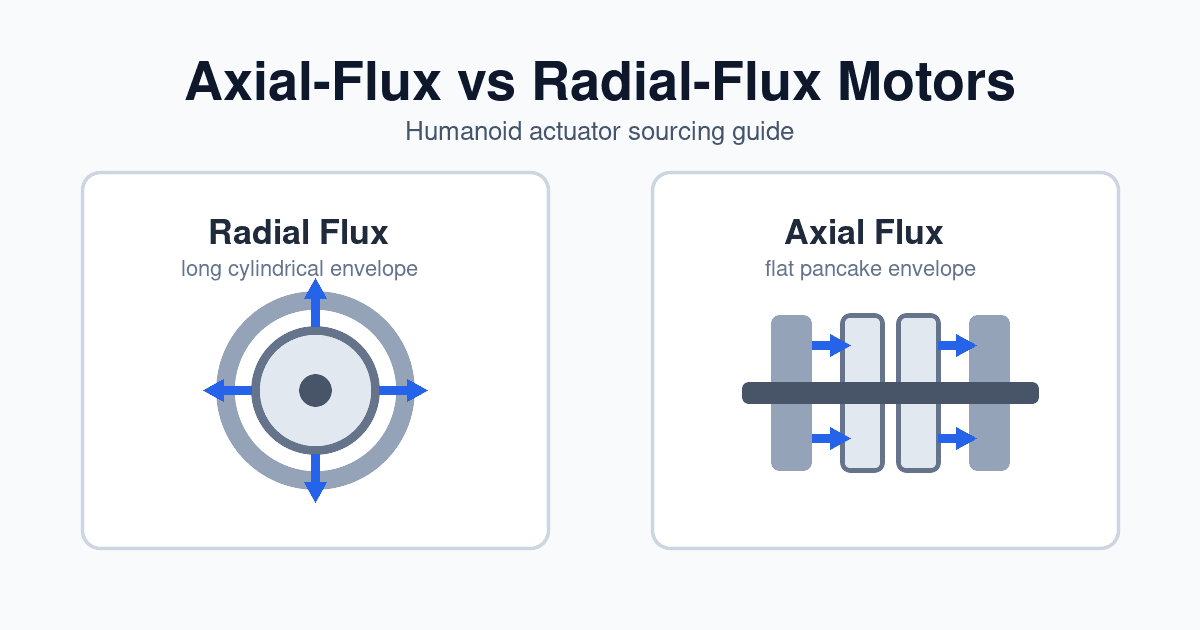
Frameless High-Torque Motors: The winding density and the grade of neodymium magnets dictate both thermal efficiency and cost. High-grade magnets (e.g., N52SH) withstand higher temperatures without demagnetizing but are subject to intense market price volatility.
Strain Wave (Harmonic) & Cycloidal Gearing: Precision machining is required to achieve zero-backlash gearing. The rejection rate (yield loss) during manufacturing is high for substandard vendors. High-quality precision gears represent up to 40% of the actuator's total BOM cost.
Dual Encoders: Achieving human-like backdrivability often requires both motor-side and output-side high-resolution absolute encoders. Securing a steady supply of these optical or magnetic chips is critical.
Use this map before sending a generic "please quote humanoid actuator" message. It narrows the RFQ to the actuator form that is most likely to survive the first engineering review.
Product family
Shortlist when
Evidence to request before sample PO
Site path
Integrated rotary joint modules
The joint needs motor, reducer, encoder, brake, driver, and housing in one compact package
Torque-speed window, protocol note, brake boundary, output support assumptions, and revision ID
As of 2026, buyers must make a critical architectural decision: do you invest in bespoke design, or do you adapt your robot to utilize emerging integrated modules?
Comparison Dimension
Custom Co-Development
Emerging Integrated Modules
Initial NRE (Non-Recurring Engineering) Cost
Very High ($100k - $500k+)
Low to Zero
Time to First Prototype (Lead Time)
6 to 12 Months
2 to 4 Weeks
Form Factor Optimization
Perfect fit for bespoke chassis designs
May require chassis compromises
Unit BOM Cost at High Volume (>10k)
Potentially lower (optimized for one task)
Higher (includes generic margins)
Unit BOM Cost at Low Volume (<500)
Extremely High
Moderate and predictable
Vendor Lock-In Risk
Critical (High dependency on sole IP owner)
Moderate (Standard interfaces emerging)
Maintenance & Replacement
Slow; requires custom batches
Fast; off-the-shelf stocking
Best Suited For
High-budget, radically unique kinematic designs
Rapid commercial scaling and iterative pilot programs
Conclusion: Unless you have secured massive capital and your robot's kinematic design is fundamentally incompatible with standard form factors, 2026 best practices dictate moving toward Integrated Joint Modules for rapid scaling.
A strong RFQ package does not need to expose every controlled drawing on day one. It should give the supplier enough engineering context to recommend a credible model while making controlled document requests traceable.
RFQ stage
Buyer should send
Supplier should return
Decision checkpoint
Initial shortlist
Robot type, joint map, torque-speed or force-stroke estimates, envelope, voltage, protocol, quantity stage, and timeline
Candidate model families, sample feasibility note, accessory boundary, and first validation gate
Can the project narrow to one or two actuator classes?
Sample readiness
Mounting constraints, controller stack, harness needs, brake expectation, and bench test plan
Datasheet, wiring or pinout note, controller match, sample acceptance checklist, and revision ID
Can the buyer power, mount, and measure the sample without a second sourcing loop?
Controlled document request
Business email, project stage, document purpose, NDA status, interface owner, and requested format
Public packet, RFQ-qualified packet, NDA-controlled CAD path, or sample validation packet
Is the requested file appropriate for the buyer's stage and permission level?
Pilot planning
Accepted sample revision, quantity ramp, inspection expectation, packaging needs, and destination country
Revision baseline, outgoing inspection record type, logistics boundary, and quality gate
Can the same configuration move from accepted sample to pilot order without uncontrolled drift?
Before issuing a high-volume Purchase Order for humanoid actuators, use this checklist to audit potential suppliers:
1. In-House Manufacturing Capabilities: Does the vendor actually machine the gearing and wind the stators, or are they merely assembling third-party parts? (Brokers mask supply chain risks).
2. Thermal Derating Data: Has the supplier provided verified continuous vs. peak torque curves at specific ambient temperatures, not just theoretical maximums?
3. Quality Yield Rates: Ask for their First Pass Yield (FPY) metrics on zero-backlash gearboxes.
4. Raw Material Traceability: Can they trace the origin of their rare-earth magnets? Are they compliant with current near-shoring or tariff avoidance strategies?
5. Communication Protocol Support: Do the integrated drivers support high-speed EtherCAT, CANopen, or proprietary low-latency protocols natively?
6. Shock & Impact Resistance Data: Humanoids fall over. Has the vendor provided MTBF (Mean Time Between Failures) data for shock loads to the output shaft?
7. Supply Chain Redundancy: If their primary CNC facility shuts down, what is their backup plan?
8. Firmware Over-The-Air (OTA) Viability: Can the actuator's internal drive firmware be updated remotely in the field to tune control loops as your software evolves?
For related product-engineering notes, the Product Engineering blog category groups actuator selection, OEM customization, and integration guidance under the same sourcing workflow.
Q: Are pneumatic or hydraulic actuators viable alternatives to electromechanical joints for humanoids?
A: While hydraulic systems can offer high force density and impact resistance, they add pumps, fluid handling, acoustic noise, leakage risk, and maintenance complexity. For commercial, indoor, and collaborative humanoids in 2026, the dominant procurement path is electromechanical: brushless motors combined with harmonic, cycloidal, planetary, or quasi-direct-drive architectures.
Q: How do we solve the heat dissipation problem in highly integrated modules?
A: Procurement must look for vendors utilizing advanced thermal potting compounds, water-cooling liquid jackets (for extreme industrial models), or highly optimized winding techniques that lower electrical resistance. Always verify the continuous torque rating, not just the 10-second peak torque.
Q: Should we buy motors and gearboxes separately to save money?
A: In 2026, "supply chain sprawl" is more expensive than the margin saved. Buying separately forces your internal engineering team to handle integration, calibration, and yield loss. Buying an integrated actuator shifts the yield risk to the vendor and drastically reduces your time-to-market.
Q: What is the typical lead time for production-scale humanoid actuators right now?
A: Treat lead time as supplier- and revision-dependent rather than a fixed market number. As a planning baseline, sample-ready integrated modules may fit a 4 to 8 week purchasing window when inventory and documentation are ready, while custom co-developed joints can push into 16 to 24 weeks because the motor, reducer, encoder, drive, tooling, and inspection plan all iterate together.
To keep the procurement strategy grounded in verifiable references, use these public sources as context:
Electromechanical humanoid direction: Boston Dynamics describes the new Atlas generation as fully electric, reinforcing why humanoid procurement teams increasingly evaluate compact electric joint modules rather than legacy hydraulic architectures (Boston Dynamics: An Electric New Era for Atlas).
Rare-earth exposure: USGS rare-earth mineral data explains why magnet supply, pricing, and origin traceability remain relevant to high-torque motor procurement (USGS Mineral Commodity Summaries 2026: Rare Earths).
Backdrivable actuator design: Published quasi-direct-drive actuator work details why low reflected inertia, high torque density, and backdrivability matter for legged and humanoid-class robotics (Open-access QDD actuator paper, PMC).
Hardware supply chain management is now a massive competitive differentiator. The companies that win the humanoid race will be those that avoid bespoke traps, standardize their architectures early, and partner with transparent, volume-capable actuator vendors.
Ready to scale your humanoid production without the headache of supply chain sprawl?
Evaluate your current Bill of Materials and ensure your actuator supplier can handle the rigorous demands of commercial deployment. Contact the engineering and procurement support team to discuss integrated, high-volume actuator solutions tailored for 2026 humanoid form factors.
Evidence route
Evidence Path for This Guide
Use this article as a sourcing decision framework. Before acting on a market or architecture claim, translate it into actuator family, joint duty, document scope, and sample gate evidence.