
Turn article assumptions into a first actuator family, model class, and evidence request.
Open catalog RFQ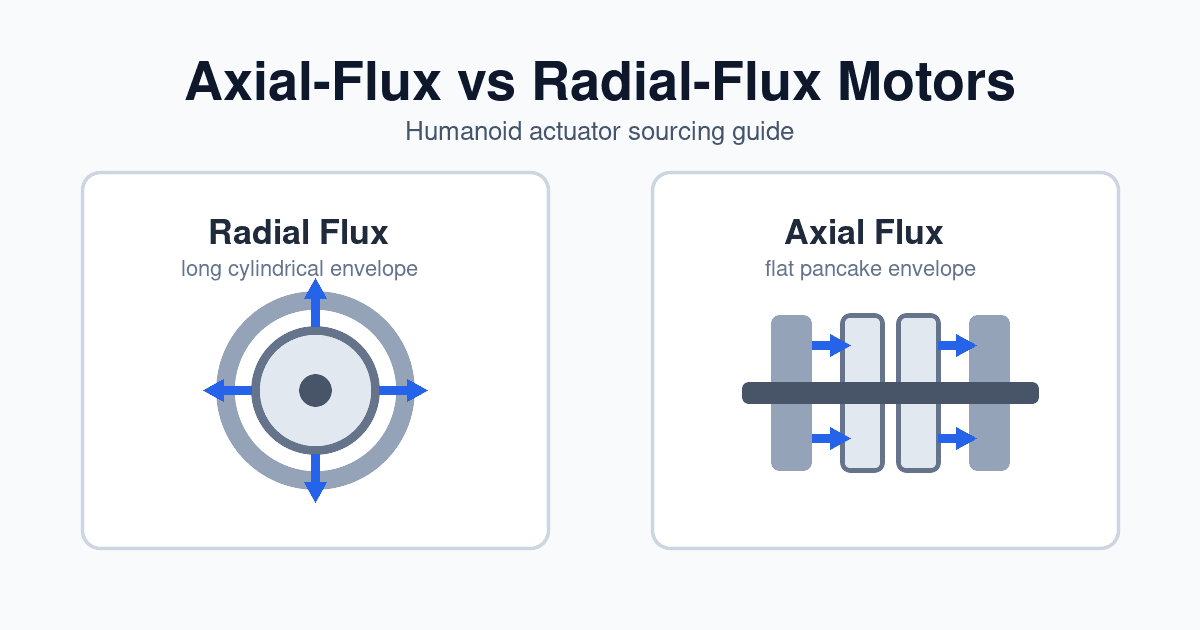
2026/07/25
Axial-Flux vs. Radial-Flux Motors for Humanoid Actuators: A 2026 Sourcing Guide
Compare axial-flux vs radial-flux motors for humanoid actuators in 2026: torque density, thermal limits, tooling cost, joint fit, and RFQ sourcing checks.
As humanoid robots transition from R&D laboratories into commercial pilot programs in 2026, engineering and procurement teams face a critical architectural fork in the road: motor topology. The core prime mover in almost every modern humanoid joint is a brushless DC (BLDC) permanent magnet synchronous motor (PMSM). However, the geometrical arrangement of the magnetic flux—specifically whether it runs radially or axially—dictates the entire mechanical envelope, thermal behavior, and supply chain complexity of the robot.
Historically, industrial automation has relied almost exclusively on radial-flux motors. They are proven, cheap to manufacture in volume, and easily sourced. But humanoid robots impose extreme Size, Weight, and Power (SWaP) constraints. Joints like the hip roll or shoulder pitch require immense torque in incredibly flat, confined spaces—a geometric reality that heavily favors the "pancake" profile of axial-flux motors.
This guide provides a comprehensive framework for robotics engineers, hardware sourcing managers, and supply chain directors to evaluate when to deploy conventional radial-flux motors and when the premium for axial-flux topologies is justified.
If your team is finalizing an actuator architecture and needs a fast assessment of custom versus off-the-shelf options, you can review our Axial Flux & SMC Solutions or consult the standard Humanoid Robot Actuator Catalog.
1. Core Physics: Understanding the Topologies
The fundamental difference between radial-flux and axial-flux motors lies in the direction of the magnetic field relative to the axis of rotation.
Radial-Flux Motors (The Cylinder)
In a radial-flux motor, the rotor and stator are arranged concentrically as nested cylinders. The magnetic flux travels radially—perpendicular to the axis of rotation—across the air gap between the rotor and stator.
- Form Factor: Long and cylindrical.
- Torque Production: Torque is a function of the rotor volume (specifically, the square of the radius multiplied by the length: $T \propto D^2L$). To get more torque without increasing the diameter, you simply make the motor longer.
- Manufacturing: Winding the stator teeth on a radial motor is a highly mature, automated process.
Axial-Flux Motors (The Disc)
In an axial-flux motor, the rotor and stator are arranged as parallel discs. The magnetic flux travels axially—parallel to the axis of rotation—across the flat air gap.
- Form Factor: Flat, short, and wide (often called "pancake" motors).
- Torque Production: Torque is a function of the rotor volume, but critically, it scales with the cube of the outer diameter ($T \propto D^3$). A slight increase in diameter yields a massive increase in torque.
- Manufacturing: Historically difficult. Winding the stator coils on a flat plane, maintaining a uniform air gap across a wide disc under heavy magnetic attraction, and managing structural deflection require precision tooling.
2. The Torque Density Imperative
In humanoid robotics, actuators are not bolted to a concrete factory floor. Every actuator must lift the mass of the actuators further down the kinematic chain. If your knee actuator is heavy, your hip actuator must be vastly larger to lift the leg, which in turn requires a massive battery, which requires an even stronger hip. This creates a cascading mass penalty.
To break this cycle, designers obsess over Torque Density (Nm/kg) and Volumetric Torque Density (Nm/L).
Because axial-flux motors utilize a larger effective radius for force generation (torque is force times distance from the center), they generate significantly more torque for a given mass compared to a radial motor of similar volume. Depending on the design, an axial-flux motor can achieve 30% to 40% higher torque density than a best-in-class radial equivalent. This makes them the ultimate enabler for high-performance, lightweight humanoid joints.
3. Joint-by-Joint Sourcing Strategy
Procurement teams must realize that a humanoid robot does not require the same motor topology for every joint. An optimized Bill of Materials (BOM) will utilize a hybrid approach, matching the form factor to the kinematic envelope.
Hip and Shoulder (Roll and Yaw Joints)
- Recommendation: Axial-Flux
- The Rationale: These joints are located at the core of the body, where lateral space (width) is strictly constrained by the robot's outer skin and natural human proportions. An actuator here must be extremely flat but deliver massive peak torque to swing the entire limb. A 20mm-thick axial-flux motor paired with a pancake harmonic drive is the gold standard here.
Knee and Elbow (Pitch Joints)
- Recommendation: Radial-Flux
- The Rationale: Knees and elbows often have more longitudinal space (along the axis of the limb bone) but strict diameter constraints to mimic human calves and forearms. A long, skinny radial-flux frameless motor fits perfectly inside the "thigh" or "bicep" tube, driving the joint via a ball screw, belt, or inline planetary gear. Axial-flux motors are generally too wide for these cylindrical limb spaces.
Ankle and Wrist
- Recommendation: Radial-Flux (Hollow Shaft)
- The Rationale: Ankles and wrists require intricate cable routing to pass power and data to sensors in the hands and feet. Radial-flux motors naturally accommodate large hollow shafts for cable passthrough. While axial-flux motors can be made hollow, doing so removes the inner magnetic material, severely degrading their torque advantage.
4. Structured Comparison Table
For hardware engineers and sourcing managers building their 2026 RFQs, here is a direct comparison of the two topologies across the criteria that matter most for scaling humanoid production.
| Evaluation Metric | Radial-Flux (Standard Frameless) | Axial-Flux (Disc/Pancake) |
|---|---|---|
| Torque Density (Mass) | Moderate to High | Industry Leading (30-40% higher) |
| Volumetric Profile | Cylindrical (Long, narrow diameter) | Pancake (Flat, wide diameter) |
| Tooling & NRE Cost | Low (Standardized stamping/winding) | High (Custom tooling, precision alignment) |
| Thermal Dissipation | Easy (Stator is on the outer perimeter) | Difficult (Stator often sandwiched between rotors) |
| Air Gap Sensitivity | Moderate (Rigid cylindrical bearings) | Extremely High (Requires massive axial stiffness) |
| Hollow Shaft Capability | Excellent (Easy cable routing) | Poor (Reduces effective magnetic area significantly) |
| Supply Chain Availability | Ubiquitous (Hundreds of global vendors) | Scarce (Limited to specialized EV/Robotics vendors) |
5. Thermal Management Realities
A high torque density rating on a datasheet is useless if the motor overheats in three seconds. Thermal management is the hidden trap in axial-flux procurement.
In a traditional radial-flux outrunner or frameless inrunner, the heat-generating component (the stator) is located on the outer perimeter or in direct contact with an outer aluminum housing. Heat easily conducts outward to the robot's chassis or air flow.
In dual-rotor axial-flux designs (the most common high-torque configuration), the heat-generating stator is sandwiched between two spinning magnetic rotors. Heat is trapped in the middle of the motor with very limited conductive paths to the outside world. To solve this in 2026, advanced suppliers are utilizing Soft Magnetic Composites (SMC) for the stator cores. SMCs are iron powder particles coated with an insulating layer and pressed into 3D shapes. They allow for intricate, omnidirectional magnetic flux paths while offering slightly better thermal pathways and reduced eddy current losses at high speeds compared to traditional laminated steel.
Procurement Tip: When evaluating an axial-flux vendor, do not just ask for peak torque. Ask for the continuous torque rating at a specified temperature limit (e.g., 80°C case temp) without liquid cooling, as humanoids generally cannot afford the weight of pumps and coolant loops.
6. The 2026 Supply Chain: Overcoming the "Pre-Modular" Gap
The biggest challenge for sourcing managers today is that axial-flux motors are still largely "pre-modular."
If you want a 100mm diameter radial frameless motor, you can download a CAD file from fifty different vendors today, order a sample for $500, and have it on your desk next week.
If you want an axial-flux motor optimized for a humanoid hip, you are often entering a custom co-development program. Vendors require Non-Recurring Engineering (NRE) fees to design the stator press tools, validate the axial bearing stiffness (to prevent the rotors from snapping together under extreme magnetic attraction), and tune the custom motor drives required by the low inductance of axial designs.
To bridge this gap, forward-thinking OEMs are offering integrated joint modules. By purchasing a pre-integrated axial motor, strain-wave gear, and dual-encoder setup, buyers shift the burden of air-gap management and thermal housing design back to the supplier.
7. Actuator Qualification Checklist
Before issuing a Purchase Order for prototype humanoid actuators, engineering and procurement teams should run through this exact checklist to avoid late-stage architectural failures.
- Kinematic Fit: Does the joint actually require a flat profile (hip/shoulder), or can a cylindrical profile (knee/elbow) fit within the limb housing?
- Thermal Duty Cycle: Has the vendor provided continuous torque data assuming purely passive conductive/convective cooling (no liquid cooling)?
- Structural Stiffness: If sourcing an axial-flux motor kit (bare rotor/stator), is your mechanical engineering team prepared to design a bearing structure capable of withstanding hundreds of pounds of axial magnetic attraction without deflecting?
- Drive Compatibility: Does the chosen motor drive support the very low phase inductance typical of axial-flux and slotless motors (requiring high PWM switching frequencies >40kHz)?
- Supply Chain Scalability: Does the vendor have the stamping and winding automation in place to scale from 10 prototype units to 10,000 units without a major factory redesign?
- Integration Path: Are you buying a bare motor, or an integrated Force-Control Actuator with built-in torque sensing?
8. Limitations and When NOT to Use Axial Flux
Despite their immense performance advantages, axial-flux motors are not a silver bullet. You should explicitly avoid them, or at least delay their implementation, under the following conditions:
- Early Prototyping Phases: If your team is just trying to prove out a walking gait algorithm, use cheap, off-the-shelf radial motors. Do not spend six months and $50,000 on custom axial-flux tooling before your software is ready.
- High Cable-Density Joints: As mentioned, ankle and wrist joints that require thick data and power cables to pass through the center of rotation are poorly suited for axial-flux.
- Strict Budget Constraints: For educational platforms, research bots, or lower-cost consumer humanoids, the premium for axial-flux manufacturing (and the complex bearing structures required to support them) will break the BOM target. Stick to high-pole-count radial outrunners.
9. Frequently Asked Questions (FAQ)
Q: Can I use standard servo drives with an axial-flux motor? A: Often, no. Axial-flux motors frequently have very low inductance. Standard industrial servo drives running at 8kHz or 16kHz PWM will cause massive current ripple, excessive heat, and poor efficiency. You typically need high-frequency drives (40kHz - 100kHz) utilizing GaN or SiC MOSFETs.
Q: What is the lead time difference between radial and axial prototypes? A: In 2026, a standard radial frameless kit can be sourced in 2-4 weeks. A custom axial-flux design typically requires 12-16 weeks for SMC stator pressing, custom magnet fabrication, and assembly tooling.
Q: Why do axial-flux motors use Soft Magnetic Composites (SMC) instead of laminated electrical steel? A: Laminated steel is easy to bend into cylinders (for radial motors) but very difficult to wrap into the complex 3D flux paths required for efficient axial stators. SMCs can be pressed into exact 3D shapes, minimizing flux leakage and reducing high-speed eddy currents in the flat topology.
Q: Do axial-flux motors require special gearboxes? A: Not inherently, but because their primary advantage is a flat form factor, pairing them with a long, cylindrical planetary gearbox defeats the purpose. They are almost exclusively paired with pancake-style strain wave gears (harmonic drives) or ultra-flat cycloidal reducers.
Q: How does the backdrivability compare? A: Backdrivability is primarily a function of the gearbox ratio and cogging torque. Because axial-flux motors generally have larger air gaps and can utilize slotless stator designs, their cogging torque can be extremely low, making them highly backdrivable—ideal for force-control interactions.
10. Conclusion and Next Steps
The decision between axial-flux and radial-flux actuators is the foundation upon which your entire humanoid robot architecture will be built. While radial motors offer supply chain safety and ease of integration, axial-flux topologies unlock the extreme torque density and compact form factors necessary for commercial-grade humanoids to match human kinematic limits.
For procurement and engineering teams navigating this transition, the most critical step is moving away from fragmented component sourcing. Partnering with suppliers that offer integrated thermal modeling, custom SMC stators, and pre-aligned module assemblies drastically reduces both technical risk and time-to-market.
Ready to evaluate the exact SWaP-C metrics for your specific joints?
- Review our specialized Axial Flux & SMC Solutions.
- For complete joint modules, explore our High-Torque Leg Actuator Modules.
- Submit your joint torque-speed maps directly through our OEM Capabilities and RFQ portal for a technical review.
Sources & References
- Equipmake: Axial flux motor vs radial flux motor - Engineering Knowledge Base (Retrieved July 2026). Explains the core volumetric differences and flux path variations.
- Brogen Motors: The Role of Axial Flux Motors in Robotics (Retrieved July 2026). Highlights the adoption of high-power axial-flux designs specifically for tight joint spaces in autonomous systems.
- Honest HLS: Axial Flux Motor: The Lifeblood of Humanoid Robots (Retrieved July 2026). Details the shift from conventional radial paths to disc-shaped stators for legged mobility.
- arXiv / Robotics Motor Design: High Torque Density PCB Axial Flux Permanent Magnet Motor for Micro Robots (Retrieved July 2026). Provides a recent robotics-focused AFPM example with a thin joint envelope, torque-density motivation, thermal analysis, and experimental validation.
Author

Categories
Buyer path
After Reading
Use the guide to choose the next sourcing action.
Convert the guide into application-risk notes before asking for samples or controlled files.
Send prototype contextCarry accepted article checklists into sample release, pilot supply, and OEM documentation control.
Prepare OEM sample plan1. Core Physics: Understanding the TopologiesRadial-Flux Motors (The Cylinder)Axial-Flux Motors (The Disc)2. The Torque Density Imperative3. Joint-by-Joint Sourcing StrategyHip and Shoulder (Roll and Yaw Joints)Knee and Elbow (Pitch Joints)Ankle and Wrist4. Structured Comparison Table5. Thermal Management Realities6. The 2026 Supply Chain: Overcoming the "Pre-Modular" Gap7. Actuator Qualification Checklist8. Limitations and When NOT to Use Axial Flux9. Frequently Asked Questions (FAQ)10. Conclusion and Next StepsSources & References
More Posts
Product Engineering
Sourcing Humanoid Robot Actuators in 2026: Overcoming Pre-Modular Bottlenecks
A 2026 procurement guide for humanoid robot actuators: qualify modules, manage pre-modular supply risk, and compare custom vs. integrated sourcing paths.
Engineering NotesProduct Engineering
Humanoid Actuator Thermal Management: Sourcing for Continuous Torque
A 2026 procurement guide to thermal derating in humanoid robot actuators. Learn how to evaluate cooling architectures and source for continuous, rather than just peak, torque.