
Use 40–60% as a bounded reference, not an OEM quote
McKinsey’s October 2025 teardown analysis reports actuation at about 40–60% of total costs, including sensors and drivers. Confirm matching scope before comparing it with a hardware-only BOM.
Model actuator costs and BOM share with your quantities and USD quotes.
First recorded · Reviewed
McKinsey’s October 2025 teardown analysis reports actuation at about 40–60% of total costs, including sensors and drivers. Confirm matching scope before comparing it with a hardware-only BOM.
Unitree publishes product specifications and a selling price, which do not establish its internal actuator cost. Do not use a product price as an OEM hardware BOM.
Strain-wave and planetary gears have different operating principles. Gear type alone does not establish whole-actuator cost, fatigue life or suitability.
Historical cost declines and roller-screw production constraints are documented. They do not validate this tool’s discount indices or an 84% learning progress ratio.
The public Goldman Sachs article gives a historical whole-robot manufacturing range. It cannot be converted into current per-joint or OEM-specific cost claims.
Humanoid Robot Actuators is a commercial actuator sourcing site. This is an editorial planning model; we have not measured an OEM BOM or conducted hardware trials. This tool supports architecture planning and quote comparison for engineering and procurement teams. It does not size motors, validate a safe robot design or estimate confidential OEM margins. Results are deterministic arithmetic, with no AI inference, server request or waiting period.
| Item | Rule | Boundary |
|---|---|---|
| Effective unit price | Base price × volume index × sourcing index, rounded to cents | An entered final quote bypasses both indices. |
| Architecture subtotal | Count × effective unit price, rounded to cents | Count purchased motorized units, not mechanical DoF. |
| Actuator percentage | Sum of architecture subtotals ÷ whole-robot hardware BOM × 100 | The denominator must include these actuators. Over 100% means the budget is exceeded. |
| Subsystem allocation | Apply the assumed architecture-specific shares to the same actuator total | This does not reveal an itemized supplier cost structure. Cents are allocated by largest remainder so parts stay non-negative and sum to the total. |
| Hardware remainder | Target hardware BOM minus actuator total | This is unallocated budget, not measured compute, structure or battery cost. |
| Excluded costs | Tooling, external assembly labor, scrap, freight, tax, software, warranty and service | Add these separately when comparing project economics. |
The source registry supports historical context and mechanism facts. No cited source validates the default prices, sourcing indices, subsystem allocations or hypothetical platform mixes. Unknown costs stay unknown until a scoped supplier quote is available.
Default base prices below are scenario anchors at the reference volume and sourcing indices of 1.00. They are not catalog quotes. The initial mixed example uses pilot volume (0.52×) and the alternative-supplier scenario (0.64×). All quoted values are final USD prices; currency conversion is outside this tool.
| Actuator architecture | Base USD/unit | Included scope | Count range |
|---|---|---|---|
| Rotary strain-wave | $1,550.00 | Motor, reducer, feedback, driver, housing | 0–40 |
| Rotary planetary | $920.00 | Motor, gears, feedback, driver, housing | 0–40 |
| Linear roller screw | $2,250.00 | Motor, screw, feedback, driver, housing | 0–24 |
| Hand micro-actuator | $240.00 | One motorized unit; not a complete hand | 0–36 |
The hardware budget accepts $500–$1,000,000 and up to two decimal places. Optional final quotes accept $0.01–$100,000 per unit. These are software boundaries, not claims about the feasible size or cost of a humanoid robot.
Use this illustrative split to plan which supplier questions to ask. A complete actuator quote may already include its encoder, bearings and driver; adding them again inflates the BOM. Larger motor or transmission shares in this model reflect assigned weights, not measured teardown findings.
Static worked example using the same calculation as the tool’s mixed preset. These shares remain assumptions even when a final unit quote is entered.
| Architecture | Motor | Transmission | Sensors | Driver | Housing |
|---|---|---|---|---|---|
| Rotary strain-wave | 24% | 38% | 14% | 14% | 10% |
| Rotary planetary | 34% | 26% | 15% | 15% | 10% |
| Linear roller screw | 20% | 44% | 14% | 12% | 10% |
| Hand micro-actuator | 32% | 30% | 18% | 12% | 8% |
Request an inclusion list before comparing suppliers: torque/force rating, motor, reducer or screw, encoder channels, electronics, brake, output bearings, calibration and acceptance testing. An inexpensive bare reducer is not comparable with a tested integrated joint.
Volume and sourcing indices change modeled unit prices; they leave entered final quotes unchanged. The following comparison holds the mixed-example counts, sourcing and hardware budget constant. It is a what-if analysis, not a fitted learning curve.
USD per robot. Same quantities, alternative-supplier index 0.64 and $42,000 hardware budget; no final unit quotes.
| Scenario | Assumed index | Validate before choosing |
|---|---|---|
| Global Tier-1 Specialized | 1× | Reference cost index; no vendor quote implied |
| Alternative Supplier Scenario | 0.64× | Assumed 0.64× cost index; validate landed cost |
| Vertically Integrated Modular | 0.48× | Assumed 0.48× parts index; excludes tooling and labor |
The January 2024 Goldman Sachs report discusses precision equipment and manufacturing constraints for planetary roller screws. This supports asking about production capability and lead time; it does not establish a universal cold-rolling yield, price floor or discount schedule. Compare landed cost, qualification expense and reliability along with the piece price.
Model names, robot generations and configurations matter. The generic presets intentionally avoid claiming that a motor count, gearbox mix or internal BOM belongs to a named OEM. These sources were checked on October 28, 2026; older announcements remain historical context.
| Platform/context | Publicly supported | Actuator BOM / share | Decision consequence |
|---|---|---|---|
| Unitree G1 | G1: 23 joint DoF; G1-EDU: 23–43, depending on configuration | Unknown from this source | Confirm configuration and count motorized units; do not equate selling price with hardware cost. |
| Electric Atlas, 2024 announcement | An electric successor to the hydraulic platform | Unknown from this source | Electric actuation alone reveals neither gearbox mix nor procurement price. |
| Humanoid manufacturing, 2024 research | Historical whole-robot estimate: $30,000–$150,000 | No platform-specific percentage established here | Keep the historical manufacturing range separate from today’s quote and hardware-only BOM. |
| Optimus / Figure scenario comparisons | No complete itemized OEM quote is established by this page’s sources | Unknown | Use generic architecture examples; request a dated BOM before attributing costs to either OEM. |
Harmonic Drive’s technical page describes strain-wave gearing using a wave generator, flexspline and circular spline, and explains planetary gear operation. The engineering questions below are a selection framework; numerical load, backlash and lifetime limits require a selected product datasheet.
| Architecture | Potential reason to consider it | Trade-off to validate | Quote boundary |
|---|---|---|---|
| Strain-wave rotary | Compact reduction and positioning | Torsional compliance, overload and thermal performance at your duty point | Include motor, output bearing and feedback; reducer-only price is incomplete. |
| Planetary rotary | Flexible ratio and modular gear stages | Backlash, friction, motor current and stiffness under load | A low ratio may require a larger motor and inverter. |
| Roller-screw linear | Convert motor rotation into controlled thrust | Stroke, buckling, lubrication, sealing and impact loading | Include linkages and mounting; a screw is not a complete linear actuator. |
| Tendon-driven hand | Place motors away from fingers | Cable routing, friction, stretch and calibration | Include transmissions and maintenance, not only micro-motors. |
A ratio such as “linear costs 1.7× rotary” is only defensible for matched specifications and quotes. The model’s baseline ratio is an assumption. It cannot substitute for a force/torque-speed requirement or account for the different linkage geometry of each architecture.
For fixed quantities and no architecture changes, increasing every effective actuator unit price by 10% increases actuator spend by about 10% after cents rounding. It does not increase the entire hardware BOM by 10%. The table keeps the target denominator fixed to show the budget impact.
| Unit price case | Actuator USD total | Actuator / target BOM |
|---|---|---|
| -10% price change | $17,515.88 | 41.70% |
| 0% price change | $19,462.10 | 46.34% |
| 10% price change | $21,408.32 | 50.97% |
For a material-specific change, use verified cost exposure: actuator spend × material fraction × material price change × pass-through. If, hypothetically, a material is 10% of actuator cost and rises 30% with full pass-through, actuator cost rises 3%. This is an arithmetic example, not a measured NdFeB or steel elasticity. Ask the supplier for the material fraction, contract pricing and substitution limits.
Hand motor count is not finger DoF. Coupled tendons can move multiple joints, and tactile sensors, finger structures and calibration may be procured separately. Count the motorized units in the calculator; track complete hand hardware in the whole-robot BOM without double counting included drivers.
| Subsystem | Ask the supplier | Risk if omitted |
|---|---|---|
| Hand mechanism | How many independently motorized units? Are tendons, fingers and tactile sensors included? | A micro-motor subtotal is mistaken for two complete hands. |
| Feedback | Which motor/output sensors, resolution, accuracy and calibration are included? | Unlike sensing packages are compared as equivalent modules. |
| Driver electronics | Bus voltage, interface, protection, switching losses and controller location? | An integrated driver is added twice or thermal hardware is omitted. |
| Thermal path | Continuous torque at which ambient, mounting and cooling conditions? | A peak rating is treated as a continuous workload capability. |
Neither dual encoders nor GaN switches create a universal dollar saving or accuracy guarantee. Evaluate controls, thermal limits and acceptance tests together. For thermal claims, request measured winding and electronics temperatures at your task duty cycle, rather than assuming cooling can be removed.
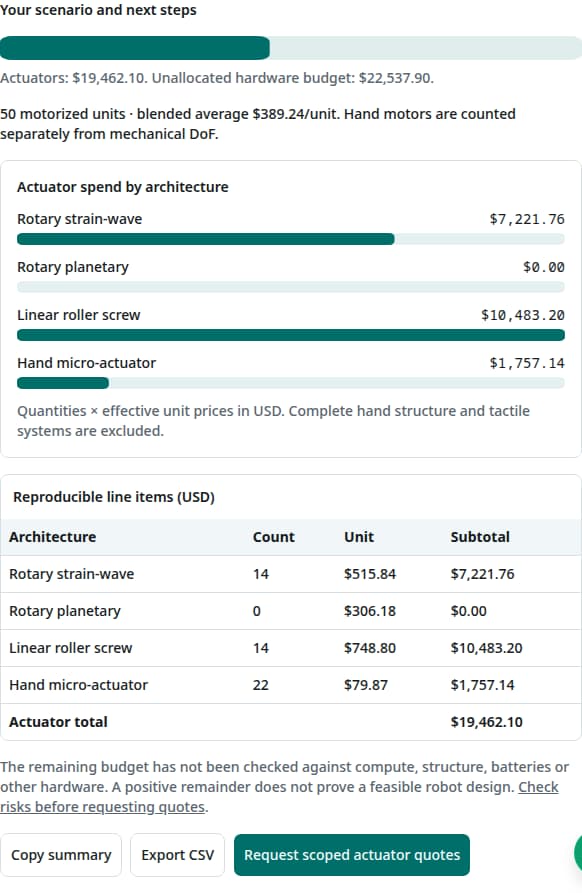
These are hypothetical design exercises, not OEM teardowns. Each row, total and percentage below is calculated by the same function as the interactive tool. Load the matching example above to reproduce the result. Each target hardware BOM is an assumption including these actuators.
Hypothetical pilot: 28 body actuators and 22 hand motors. This is not an Optimus teardown or quote.
Pilot Production · volume index 0.52× · sourcing index 0.64×.
| Line | Units × USD | Subtotal USD |
|---|---|---|
| Rotary strain-wave | 14 × $515.84 | $7,221.76 |
| Linear roller screw | 14 × $748.80 | $10,483.20 |
| Hand micro-actuator | 22 × $79.87 | $1,757.14 |
$19,462.10 / $42,000.00 = 46.34%
Next: verify linear module scope and thrust/stroke requirements before treating this scenario as a procurement budget.
Reproduce in the calculatorHypothetical series build: 23 body actuators and 10 hand motors. No Unitree gearbox mix or manufacturing cost is implied.
Series Production · volume index 0.28× · sourcing index 0.48×.
| Line | Units × USD | Subtotal USD |
|---|---|---|
| Rotary strain-wave | 8 × $208.32 | $1,666.56 |
| Rotary planetary | 15 × $123.65 | $1,854.75 |
| Hand micro-actuator | 10 × $32.26 | $322.60 |
$3,843.91 / $16,000.00 = 24.02%
Next: verify planetary actuator duty rating and the full landed quote before treating this scenario as a procurement budget.
Reproduce in the calculatorHypothetical pilot: 32 body actuators and 16 hand motors. Motor counts are not equivalent to finger degrees of freedom.
Pilot Production · volume index 0.52× · sourcing index 0.64×.
| Line | Units × USD | Subtotal USD |
|---|---|---|
| Rotary strain-wave | 20 × $515.84 | $10,316.80 |
| Rotary planetary | 12 × $306.18 | $3,674.16 |
| Hand micro-actuator | 16 × $79.87 | $1,277.92 |
$15,268.88 / $48,000.00 = 31.81%
Next: verify hand motor count, complete hand hardware and feedback before treating this scenario as a procurement budget.
Reproduce in the calculator| Risk | How it changes the decision | Minimum mitigation / alternative |
|---|---|---|
| Retail price used as BOM | The percentage appears artificially low or cannot be interpreted as hardware share. | Obtain a hardware BOM. If unavailable, label the denominator as selling price and report a different ratio outside this tool. |
| Volume indices mistaken for a forecast | Tooling, scrap and qualification costs can erase assumed piece-price savings. | Ask for dated quotations at prototype, pilot and series volumes with fixed-cost breakdowns. |
| Peak torque used for sustained lifting | The selected module may overheat despite a favorable unit price. | Validate continuous torque/force with test reports at the actual duty cycle, mounting and ambient conditions. |
| One quote applied to unequal joint loads | A uniform architecture average hides expensive hips, knees or payload joints. | Use a per-joint BOM outside this grouped model when torque or force ratings differ substantially. |
| Subsystem/body-zone allocations treated as measurements | A modeled pie can be mistaken for a supplier teardown. | Request itemized data; keep unavailable shares unknown. No body-zone cost is inferred from a named robot here. |
| Incomplete hand or driver scope | Missing mechanisms or duplicated electronics alter both numerator and denominator. | Reconcile inclusion lists and count purchased units separately from DoF. |
| Over-budget result or unvalidated remainder | A percentage alone does not show a feasible complete robot. | Re-price the architecture and build the remaining hardware BOM. A positive remainder is not a feasibility check. |
No cost evidence available? Keep the exported scenario explicitly hypothetical and request quotes using the requirement list above. The minimum alternative is a spreadsheet with joint count, quote scope, unit price, quantity and a dated hardware denominator.
Request scoped actuator quotesMcKinsey’s October 15, 2025 teardown analysis places actuation at about 40–60% of total costs, including integrated sensors and drivers. It is a broad reference, not a verified OEM percentage. For your design, divide included actuator cost by the hardware BOM at matching volume, currency and scope, then multiply by 100. See the dated source registry below.
No. Selling price includes commercial margin and may include software, warranty and distribution. Use a hardware BOM that includes the same actuator assemblies counted in the numerator. If only retail price is known, label a separate price ratio rather than calling it BOM share.
Include hand motors if they belong to the hardware scope, and keep their controllers and transmissions consistent. The hand row models motorized units, not complete hands, tactile skins or mechanical finger degrees of freedom. Add the remaining hand hardware to the whole-robot BOM.
The actuator estimate exceeds the target hardware budget. A valid BOM share cannot exceed 100 percent. Check unit pricing, quantities, currency and duplicated controllers; then revise the target budget or architecture. The tool reports the budget shortfall instead of normalizing the ratio.
For each architecture, multiply actuator count by effective unit price, round the line total to USD cents, and sum the lines. Divide that total by the target hardware BOM. Subsystem and body-zone allocations are illustrative partitions of that same total.
They are editorial scenario assumptions: $1,550 for rotary strain-wave, $920 for rotary planetary, $2,250 for linear roller screw and $240 per hand micro-actuator before multipliers. They are not verified market averages. Replace them with dated, scope-matched supplier quotes before a buying decision.
No. The 1.00, 0.52, 0.28 and 0.16 volume indices are what-if assumptions, not fitted Wright’s Law coefficients or supplier commitments. They do not account for tooling amortization, yield, working capital or qualification costs.
No. An entered quote is a final USD unit price and bypasses both volume and sourcing multipliers. Clear the quote field to return that row to the default model. Re-quote at each volume instead of applying an assumed discount to a supplier commitment.
No. The fixed allocations split each modeled actuator line into motor, transmission, sensing, electronics and housing. They show how assumptions affect totals. A quote override updates cost but does not prove the internal cost split; request itemized supplier data for that.
Not necessarily. Coupled hands, tendons and parallel linkages may use fewer motors than mechanical joints, while redundant actuation may use more. Count purchased motorized units in this cost model and document the mechanical degrees of freedom separately.
No universal price ratio is established here. Load, stroke, speed, encoder scope, tolerance, lifetime and batch size determine the comparison. This model assumes a higher linear baseline; compare matched supplier quotes and linkage costs for a real design.
Only after checking output torque, stiffness, backlash, efficiency, mass and control requirements. Harmonic Drive’s technical explanation distinguishes the gear mechanisms but does not establish a universal cost saving. Validate the full actuator under the required duty cycle.
Compare delivered module cost against internal parts, winding, assembly, calibration, scrap, test equipment and engineering costs. In-house parts may look cheaper while requiring more fixed investment. Use actual annual volume and an amortization plan; no universal crossover volume is established.
No. The alternative-supplier and in-house indices are hypothetical cost cases, not a ranking of countries or named vendors. Compare specification-matched landed quotes with the same shipping terms, quality evidence, warranty and delivery schedule.
Use actuator spend multiplied by the verified material cost fraction and the material price change, assuming full pass-through. For example, a hypothetical 10 percent material fraction and 30 percent price increase produces a 3 percent actuator-cost increase. Actual exposure and pass-through require supplier evidence.
Tooling, engineering, assembly labor outside purchased modules, scrap, freight, tax, software, warranty, certification and service are excluded. The remainder of the hardware budget is unallocated; it is not an independently estimated compute, structure or battery BOM.
No such saving is assumed. Driver losses, switching frequency, winding losses, housing conduction and ambient conditions must be measured together. Ask for thermal test results at the proposed voltage and duty cycle, including any cooling hardware and controller costs in the quote.
Request torque-speed and thermal test data with ambient temperature, cooling, mounting, duration and winding limits stated. Peak torque is not a continuous duty rating. Compare quotes at the same operating point and validate safe operating limits with the supplier.
Specify output torque or force, speed or stroke, duty cycle, bus voltage, envelope, mass, feedback, brake, backlash, environment, interfaces, quantity, delivery date and acceptance tests. State whether the price includes the driver, bearings, calibration and taxes.
Keep the unknown visible. Export a scenario with its assumptions, obtain at least two specification-matched supplier quotes, and replace the effective unit prices. Do not infer an OEM’s confidential actuator spend from marketing videos, retail price or a different robot generation.
Evidence reviewed October 28, 2026. Publication dates below belong to the sources; they are not fresh quotes. Undated pages are labeled with the access date. These sources do not establish exact OEM cost shares, material elasticities, cold-rolling yields or a validated actuator learning curve.
Review policy: the publisher will recheck this model and source scope within six months, by April 28, 2027, or sooner when the assumptions or cited evidence change. Supplier quotes need their own expiry dates.
McKinsey & Company · October 15, 2025
Its teardown analysis places actuation at about 40–60% of total costs, including integrated sensors and drivers. This broad scope is not a verified share for a named OEM or a calibration of this calculator.
Goldman Sachs Research · February 27, 2024
Historical whole-robot manufacturing estimates of $30,000–$150,000. These are neither current actuator quotes nor an OEM-specific BOM share.
Goldman Sachs Research · January 8, 2024
Printed page 15 discusses roller-screw equipment, know-how and capacity constraints. It does not establish this calculator’s prices or volume discounts.
Unitree Robotics · Live specification page; accessed October 28, 2026
G1 lists 23 joint DoF; G1-EDU lists 23–43 depending on configuration. Product specifications and selling prices do not disclose internal manufacturing BOM cost.
Harmonic Drive LLC · Undated technical page; accessed October 28, 2026
Explains strain-wave and planetary mechanisms. It supports mechanism distinctions, not a universal price premium or cost share.
Boston Dynamics · 2024 electric-platform announcement; accessed October 28, 2026
Confirms the move to an electric platform. It does not disclose actuator procurement prices or a hardware BOM percentage.
Save a scenario, validate its quotes and resolve unknown costs before making an architecture commitment. Use the supporting guides for component scope and supplier selection.